Moving to Malta from Ireland: A Complete Guide
Malta Relocation & Residency News
7th September 2026
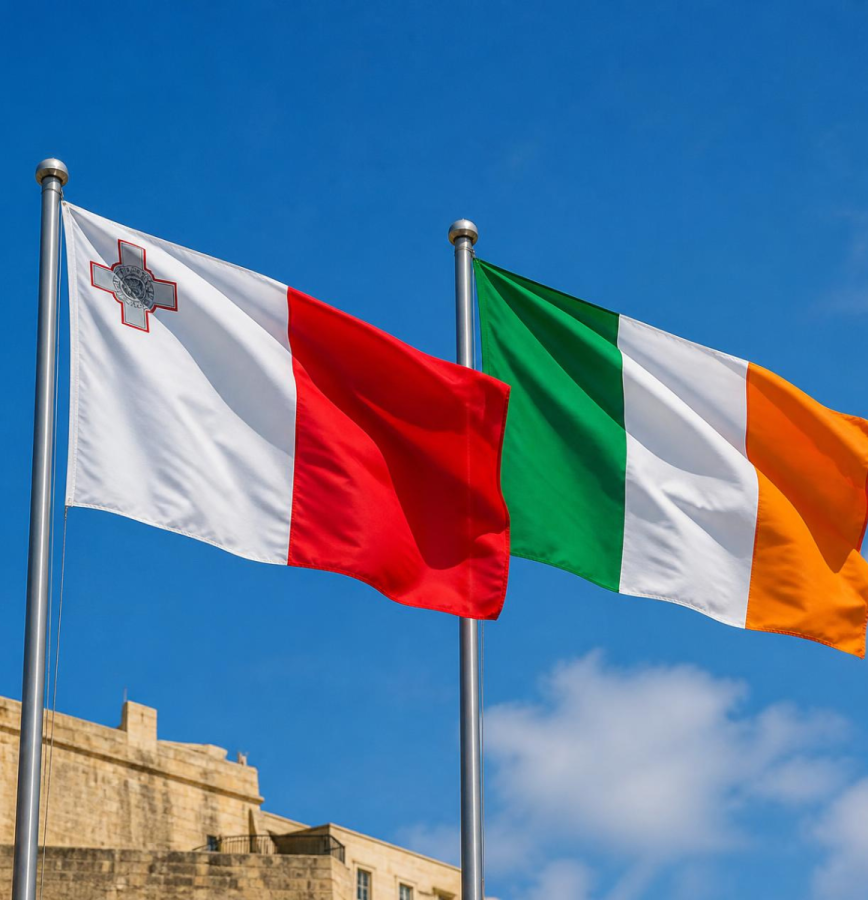
For Irish citizens, relocating to Malta combines the advantages of European Union freedom of movement with the appeal of a Mediterranean lifestyle. The two countries share English as an official language, making everyday life, employment and business significantly easier than in many other European destinations. Combined with year-round sunshine, a well-established international business environment and convenient access to mainland Europe, Malta has become an increasingly popular choice for Irish professionals, entrepreneurs, retirees, remote workers and families.
As fellow European Union member states, Ireland and Malta allow their citizens to live, work, study and establish themselves in each other's countries without requiring a visa. Irish citizens intending to remain in Malta for longer than three months must, however, register their residence with Identità Malta and complete the relevant administrative formalities. One important distinction is that, unlike Malta, Ireland is not part of the Schengen Area. While this does not affect an Irish citizen's right to relocate to Malta, it does influence how travel between Ireland, Malta and other European countries is managed.
This article explains everything Irish citizens need to know before moving to Malta, including residence registration, employment, taxation, healthcare, property ownership and the practical considerations involved in making the move.
Quick Facts for Irish Citizens Moving to Malta
Irish citizens benefit from one of the simplest relocation pathways to Malta thanks to European Union freedom of movement. Nevertheless, understanding the key administrative requirements before relocating can make the process significantly smoother.
|
Topic |
Key Information |
|
Visa |
Irish citizens do not need a visa to enter Malta. |
|
First three months |
EU citizens may live in Malta for up to three months without obtaining a registration certificate. |
|
After three months |
Irish citizens remaining in Malta for longer than three months must register with ID Malta and obtain an eResidence document. |
|
Employment |
Irish citizens may work in Malta without a Single Permit, although employment should be properly registered. |
|
Self employment |
Freelancers and business owners may require tax, VAT, National Insurance and Jobsplus registration depending on their activities. |
|
Healthcare |
The European Health Insurance Card may assist during temporary stays, but long-term residents should understand Maltese social security, S1 entitlement or private healthcare requirements. |
|
Tax |
Spending more than 183 days in Malta during a calendar year will generally result in Maltese tax residency for that year. |
|
Property |
Irish citizens benefit from EU property ownership rules, although restrictions relating to secondary residences may still apply before completing five years of continuous residence in Malta. |
|
Driving |
A valid Irish driving licence is recognised throughout Malta. |
Entry, Residence and eResidence Registration
Moving from Ireland to Malta is administratively straightforward compared with relocation from countries outside the European Union. Nevertheless, Irish citizens planning a long-term move should understand when residence registration becomes necessary and what supporting documentation may be required.
Do Irish Citizens Need a Visa for Malta?
No. Irish citizens do not require a visa or Schengen visa to enter Malta because Ireland and Malta are both members of the European Union. They may travel to Malta for relocation planning, property viewings, employment, self-employment, study, retirement or simply to explore the island before making a permanent move.
Staying in Malta for Longer Than Three Months as an Irish National
Irish citizens intending to remain in Malta for more than three months must register their residence with Identità Malta. Applications are generally submitted online through the Expatriates Portal, with the residence category determined by the purpose of the move. Common categories include employment, self-employment, study, family reunification and economic self-sufficiency. After five years of continuous legal residence while exercising EU treaty rights, Irish citizens may become eligible for permanent residence.
What Documents Irish Citizens Moving to Malta May Need
The documents required depend on the chosen residence category, but applicants will commonly be asked to provide;
- A valid Irish passport or passport card where accepted.
- An employment contract or evidence of self-employment where applicable.
- Proof of sufficient financial resources or pension income for self-sufficient applicants.
- Evidence of healthcare cover such as an S1 certificate or private health insurance where relevant, and a lease agreement or proof of property ownership.
Families relocating together may also need to provide birth or marriage certificates to support their applications.
Working, Self-Employment and Remote Work in Malta as an Irish National
Irish citizens may work, establish a business or become self-employed in Malta without obtaining a Single Permit. As European Union citizens, they have direct access to Malta's labour market, although employment, tax and social security obligations must still be completed after relocating.
Malta's internationally focused economy creates opportunities across a broad range of sectors, including iGaming, technology, financial services, compliance, insurance, aviation, maritime services, hospitality, healthcare, education, real estate and other professional services. Many Irish professionals are attracted by the combination of career opportunities, an English-speaking business environment and the island's proximity to the rest of Europe.
Malta Self-Employment and Remote Work for Irish Citizens
Irish freelancers, consultants, company owners and remote workers do not require Malta's Nomad Residence Permit, which is intended for third-country nationals. Instead, they may establish themselves in Malta under European Union freedom of movement, provided they meet the relevant registration and tax requirements.
Depending on the nature of their activities, this may include tax and VAT registration, National Insurance contributions, Jobsplus registration where applicable, and compliance with A1 certificate requirements for cross-border workers. Those operating businesses across multiple jurisdictions should also consider the potential tax implications of creating a permanent establishment and obtain professional advice where appropriate.
Healthcare for Irish Citizens in Malta
Planning your healthcare arrangements is an important part of relocating from Ireland to Malta. As both countries are members of the European Union, Irish citizens benefit from reciprocal healthcare arrangements, although these are intended primarily for temporary stays rather than permanent relocation.
Using Your European Health Insurance Card (EHIC) in Malta
For short visits, the European Health Insurance Card (EHIC) allows eligible Irish residents to access medically necessary public healthcare in Malta under the same conditions as Maltese residents. The Irish Health Service Executive also confirms that certain individuals, including qualifying pensioners with a registered S1 form and posted workers, may be entitled to an Irish-issued EHIC in specific circumstances. However, the EHIC is not designed to provide comprehensive healthcare cover for people who have permanently relocated.
Healthcare for Long-Term Irish Residents in Malta
Once living in Malta, healthcare entitlement depends on your individual circumstances. Irish citizens who are employed or self-employed in Malta will generally access the public healthcare system through Maltese social security contributions. Pensioners who qualify under EU social security coordination rules may be able to transfer their healthcare entitlement using an S1 certificate, while economically self-sufficient residents who are not contributing to the Maltese system will typically need comprehensive private health insurance.
Malta also has a well-established private healthcare sector, offering access to private hospitals, specialist consultants and clinics across the island. Before relocating, it is advisable to obtain copies of your medical records, ensure any ongoing prescriptions can be continued in Malta and confirm the availability of specialist treatments or long-term medication where necessary
Irish and Maltese Tax Planning
Relocating to Malta involves more than changing your address. Tax residence in Ireland and Malta is determined under separate legal frameworks, meaning moving abroad does not automatically end your Irish tax obligations or make you exclusively taxable in Malta. Understanding how the two systems interact before relocating can help avoid unexpected liabilities and ensure your affairs are structured appropriately.
Leaving Ireland for Tax Purposes
Before moving to Malta, Irish citizens should review their tax position with Irish Revenue. Depending on their circumstances, individuals may become non-resident for Irish tax purposes after leaving Ireland, but factors such as ordinary residence, domicile and the nature of their income can continue to influence how they are taxed.
Particular attention should be given to ongoing Irish-source income, including rental income from Irish property, business interests, investments, pensions and certain capital gains. Individuals relocating during the tax year should also consider whether split-year treatment may apply to employment income and whether any Irish tax filing obligations remain after departure.
Because the interaction between tax residence, ordinary residence and domicile can vary significantly from one person to another, obtaining professional advice before relocating is strongly recommended.
Malta Tax Residence for Irish Citizens
Tax residence in Malta is separate from immigration or residence status. While the amount of time spent in Malta is an important consideration, the Maltese tax authorities also consider factors such as an individual's ordinary residence, domicile, personal circumstances and intention to establish residence when determining their tax position.
As a result, becoming resident in Malta does not automatically end Irish tax residence, and it is possible for both countries' tax rules to apply until an individual's position has been properly established.
Ireland and Malta Double Tax Treaty
Ireland and Malta have a Double Taxation Agreement designed to reduce the risk of the same income being taxed in both countries. Depending on an individual's circumstances, the treaty may apply to employment income, business profits, pensions, dividends, interest, royalties and certain capital gains.
The treaty does not remove the need to comply with the tax rules of either country, but it helps determine which country has taxing rights in different situations. Anyone relocating permanently should seek professional tax advice to understand how the agreement applies to their personal circumstances and to ensure ongoing compliance with both Irish and Maltese tax obligations.
Renting or Buying Property in Malta as an Irish National
Finding the right home is one of the most important decisions when relocating from Ireland to Malta. Although the island is compact, each locality offers a distinct lifestyle, from bustling waterfront districts to quieter residential villages. Many Irish citizens choose to rent initially, giving themselves time to explore different areas before committing to a property purchase.
Renting Before Buying
Renting during your first few months in Malta provides the flexibility to experience different neighbourhoods, commuting routes and everyday amenities before making a long-term investment. It also allows time to decide whether coastal apartment living or a quieter residential community better suits your lifestyle.
Professionals often gravitate towards Sliema and St Julian's for their proximity to business districts, restaurants and nightlife, while families frequently favour Naxxar, Attard, Lija and Balzan for their residential character and access to schools. Buyers seeking more space may be drawn to Mellieha or Gozo, whereas Valletta and the Three Cities appeal to those looking for historic homes and a vibrant cultural setting.
Before signing a lease, it is worth reviewing the rental term, security deposit, utility costs, parking availability, commuting times and any nearby construction projects that could affect day-to-day living.
Buying Property in Malta as an Irish Citizen
As European Union citizens, Irish nationals benefit from more favourable property ownership rules than non-EU buyers. In most cases, Irish citizens do not require an Acquisition of Immovable Property (AIP) Permit when purchasing a primary residence in Malta or property for business purposes. Different rules may apply to secondary residences, particularly for buyers who have not yet completed five years of continuous residence in Malta, unless the property is located within a Special Designated Area.
Purchasing property typically involves signing a Promise of Sale Agreement known as a Konvenju in Malta, followed by legal due diligence carried out by a Maltese notary, source of funds verification, mortgage approval where required and completion of the final deed of sale. Buyers should also budget for stamp duty, notarial fees and any associated legal or financing costs.
For Irish buyers unfamiliar with the Maltese property market, working with an experienced local estate agency such as Malta Sotheby’s International Realty and independent legal advisors can help ensure the transaction progresses smoothly and that all regulatory requirements are met.
Cost of Living and Daily Life in Malta Compared to Ireland
Comparing the cost of living in Malta with Ireland requires looking beyond headline figures. While some aspects of everyday life may offer better value, others can be more expensive depending on where you choose to live and the lifestyle you maintain. Anyone planning on moving to Malta from Ireland should consider housing, utilities, transport and day-to-day expenses as part of their relocation budget.
Housing is often the biggest expense in both countries. Rental prices in Sliema and St Julian's can compare with some areas of Dublin, particularly for modern apartments in prime seafront locations. However, Malta also offers more affordable options in towns such as Marsaskala, Mosta, Żabbar and parts of Gozo, where larger properties may be available at lower prices.
When comparing day-to-day living, it is worth keeping the following in mind:
- Housing: Apartments in Malta are generally more compact than many Irish homes, particularly in central urban areas.
- Utilities: Winter heating costs are typically much lower than in Ireland, although electricity bills often rise during the summer because of air conditioning.
- Groceries: Fresh local fruit, vegetables, seafood and Mediterranean produce are often reasonably priced, while imported products and international supermarket brands can cost noticeably more.
- Transport: Although Malta is geographically small, traffic congestion and limited parking are common, particularly during peak commuting hours.
Many Irish expats find Malta easy to adapt to thanks to the widespread use of English, the shared use of the euro and familiar legal and administrative systems. While both countries have strong cultural identities, Malta's Mediterranean climate encourages a more outdoor-oriented lifestyle, with cafés, waterfront promenades and beaches becoming part of everyday life for much of the year.
Driving, Shipping, Pets and Family Practicalities when Moving to Malta from Ireland
Although relocating from Ireland to Malta is relatively straightforward, taking care of a few practical arrangements before departure can make settling into everyday life much easier.
Driving in Malta
One advantage for Irish citizens is that both Ireland and Malta drive on the left-hand side of the road, making the transition considerably easier than it is for many other European nationals. Irish driving licences are recognised in Malta as valid EU licences, and those who establish their normal residence may choose to exchange their licence for a Maltese one after meeting the applicable residence requirements. While the driving orientation is familiar, motorists should still be prepared for narrower roads, heavier traffic in urban areas and more limited parking than they may be used to in Ireland.
Shipping Household Belongings
Moving household goods from Ireland is generally simpler than relocating from outside the European Union, as customs procedures are considerably less complex. Before arranging a removal company, it is worth comparing quotations, confirming transit insurance and deciding whether temporary storage will be needed if permanent accommodation is not yet available. Because many long-term rental properties in Malta are fully furnished, some new arrivals choose to bring only essential personal belongings and purchase additional items after settling in.
Moving with Pets
Travelling with pets is also relatively straightforward within the European Union, provided the relevant animal health requirements are met before departure. For most dogs, cats and ferrets, this includes a valid EU pet passport, an ISO-compliant microchip and an up-to-date rabies vaccination. Owners should also confirm any carrier requirements before travelling and ensure Malta's entry requirements have been satisfied.
Family Practicalities
Families relocating from Ireland should begin planning well before the move by arranging school enrolment, childcare where required and suitable accommodation. Completing these practical arrangements in advance can help make the transition smoother for both parents and children.
Practical Relocation Checklist for Irish Nationals Moving to Malta
A well-planned move can make settling into life in Malta much easier. Completing the following tasks before leaving Ireland and during your first few weeks after arrival will help minimise delays and ensure your relocation gets off to a smooth start.
Before Leaving Ireland
- Confirm whether you are relocating for employment, self-employment, study, retirement or family reasons.
- Ensure your passport or Irish passport card remains valid for travel.
- Gather employment, pension, savings, healthcare and accommodation documentation.
- Review your Irish tax position, including ordinary residence and any split-year treatment that may apply.
- Obtain a European Health Insurance Card (EHIC) and request an S1 certificate if you qualify.
- Decide whether to rent before purchasing a property in Malta.
- Research the property ownership rules that apply to EU citizens.
- Arrange pet travel and obtain quotations for international removals if shipping household belongings.
- Collect school records and other documentation if relocating with children.
After Arriving in Malta
- Secure long-term accommodation if you have not already done so.
- Register your residence with Identità Malta if you intend to remain in Malta for longer than three months.
- Open a Maltese bank account.
- Register your employment or self-employment where required.
- Complete your Maltese tax and social security registrations.
- Confirm your long-term healthcare arrangements.
- Arrange utilities, internet and any necessary insurance.
- Familiarise yourself with local transport options and driving requirements.
Relocating from Ireland to Malta is about more than finding a new address – it is about finding the right home, the right community and the right opportunities for the future. Whether you are searching for a waterfront apartment, a family home, an investment property or a luxury villa, having experienced local guidance can make every stage of the journey more straightforward.
Malta Sotheby's International Realty combines exceptional local market knowledge with the global reach of the Sotheby's International Realty network, helping buyers identify properties that align with their lifestyle, investment objectives and long-term plans. From the initial property search through to completing your purchase, the team is committed to delivering a seamless and personalised experience.
To begin your property search or discuss your relocation plans, contact Malta Sotheby's International Realty on +356 2010 8077, visit www.maltasothebysrealty.com or meet the team at their offices at Portomaso Marina or Tigné Point Pjazza. Whether you are planning your move or ready to find your ideal home in Malta, their experienced property professionals are ready to assist.